This worksheet 14 contains questions based on Chapter 14 Thermal Energy with
complete answers.
.png "NIOS Class 10 Science Worksheet 14 Questions Answers – Thermal Energy")
This post explains the answers of questions given in the worksheet including
explanation, diagrams. These solutions will help you complete your assignments
and TMA also.
Thermal Energy Worksheet 14 Solution
A complete solution of Questions given in the worksheet 14 of Thermal Energy of
NIOS Class 10 Science.
Q1. Thermal energy is the energy due to which we feel hot or cold and it is an important form of energy and it gets connected intimately with our life and comfort. Observe your surroundings and mention its role in our life.
Answer
Thermal energy plays a very important role in our daily life. We can see its effects
everywhere around us. Without thermal energy, we cannot perform essential works of our daily routine. Following are some examples:
1. Cooking food: – We use heat to cook vegetable, rice and other food. We use thermal energy in various forms like LPG, heater
etc.
2. Keeping warm in winter: – We sit near heater or in sunlight to stay warm. This is
possible because of thermal energy.
3. Drying clothes: – The heat from the sun helps in drying our clothes.
4. Boiling water: – We use heat to boil water, making tea.
5. In industries: – Heat from different sources is used in industries for melting
metals, shaping plastics etc.
Q2. The term temperature and heat are often used interchangeably
in everyday language. In Physics is there any difference between temperature
and heat?
a) If yes, support your answer with reasons.
b) If no, support your answer with reasons.
Answer
Yes, heat and temperature are different in Physics.
Reason
1. Heat is a form of energy but temperature is a measure of hotness or coldness.
2. Heat is measured in Joules (J) and temperature is measured in degree Celsius (ºC).
3. Heat flows from hot objects to cold objects but temperature does not flow. So, heat and temperature are not same.
Q3. Write an activity for understanding the concept that heat a temperature are intimately related.
Answer
We can easily explain through an activity that heat and temperature are intimately
related.
We will use following materials – beaker, tripod stand, spirit lamp, water, thermometer.
Steps of activity
1. We fill water in the beaker and measure its initial temperature using a thermometer.
2. We place the beaker on the triploid stand and start heating it with a burner.
3. We note down the temperature of water after every 1 -2 minutes.
Observation and conclusion
When we heat water continuously, the temperature keeps rising continuously.So, this activity shows that heat and temperature are closely related.
Q4. It is generally observed that whenever a patient is brought to a doctor, the doctor
normally measures patient’s body temperature. Name the device the doctor uses
to measure patient’s body temperature and explain working of the device.
Answer
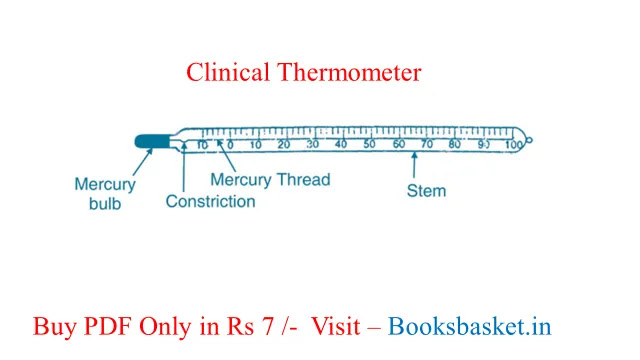
The doctor uses a clinical thermometer to measure the patient’s body temperature.
Working of Thermometer
A clinical thermometer is a mercury in glass thermometer to measure body temperature.
The thermometer is placed under tongue or armpit; the mercury rises in the glass
tube due to body heat.
The height to which mercury rises shows the patient’s body temperature on the scale
marked on the thermometer. This instrument measure temperature between 35 ºC to
42 ºC which is the normal human body temperature range.
Q5. Continue to Q4 do we have different thermometers for different purposes. Differentiate different types of thermometers which are used for different purposes.
Answer
We have different types of thermometers for different purposes.
1. Clinical Thermometer: – This is used to measure body temperature. Its range is between 35 ºC to 42ºC. this contains mercury. This thermometer is used by the doctors.
2. Laboratory thermometer: – This thermometer is used in science experiments in laboratories. Its range is between 10 ºC to 110 ºC. it has long tube filled with mercury.
.webp "NIOS Class 10 Science Worksheet 14 laboratory thermometer")
3. Maximum -Minimum thermometer: – This thermometer is used to measure the highest and lowest temperature of the day. It is used by meteorologists (weather
department). It has two scales – Celsius and Fahrenheit. It shows both maximum
and minimum temperature using U shaped glass tube with mercury.
.webp "NIOS Class 10 Science Worksheet 14 maximum -minimum thermometer")
4. Digital thermometer: – This is used for fast and safe temperature measurement. It has no mercury. It give reading on a digital display. It is used to measure body
temperature and for other purposes.
.webp "NIOS Class 10 Science Worksheet 14 digital thermometer")
Q6. Write a note on construction of Thermometer and give reasons why use of mercury (not any other liquid) is preferred as thermometric liquid.
Answer
Construction of thermometer
A thermometer is usually made of a thin willed glass bulb attached to a long narrow glass tube called a capillary. The glass bulb is filled with mercury by heating and cooling repeatedly. The capillary tube is made vacuum and then sealed.
The temperature scale is marked on it by keeping first in melting ice to mark the lower fixed point and then in steam to mark the upper fixed point. After that the space between two points is divided into equal parts to make Celsius, Fahrenheit or Kelvin scales.
.webp "NIOS Class 10 Science Worksheet 14 construction of thermometer")
Why mercury is preferred as a thermometric liquid
Mercury takes the temperature quickly and reaches the temperature of the body. It absorbs very little heat and it expands uniformly and gives accurate readings.
Mercury remains liquid over a wide temperature range and does not stick to glass. Due to these properties, mercury is the most suitable and accurate liquid.
Q7. Observe your surroundings and list effects of heat in our daily life.
Answer
Effects of heat in our daily life
1. When we heat water, milk or other food, their temperature rises and they become hot.
2. Change in state of matter occurs due to heat. Ice melts and water boils when heat is
supplied.
3. Metals or metals objects expand when heated. The railway tracks have gaps because metal expand in summer.
4. The heat of the sun evaporates water form wet clothes.
5. The sun’s heat cause evaporation, forms clouds and cause rain. So, heat is
responsible for weather change.
Q8. Write one activity for understanding the concept expansion in solids, liquids and gases when heat is supplied to solids, liquids and gases.
Answer
Activity showing Expansion of Solids, Liquids and Gases
(A) Expansion of Solids
Materials: – Metal ball and ring, burner
Procedure: – We take a metal ring with handle and pass metal ball through the ring. Now we heat the metal ball and try to pass again through the metal ring.
Observation: – The heated ball does not pass through the ring because it has expanded after heating.
Conclusion :- This activity shows that solids expand when heated.
(B) Expansion of Liquids
Materials :- Bottle filled with water, cork, straw and warm water
Procedure: – We fill the bottle with water and insert a straw through a cork. Now we mark the intial water level in the straw. Now we place this bottle in warm water or
heat it.
Observation: – The water level in the straw drop but rises on continuously heating.
Conclusion: – This activity explains that liquids expand when heated.
(C) Expansion of Gases
Materials: – Narrow glass tube, drop of mercury, candle
Procedure: – We trap a small air column inside the tube with a mercury drop and hold the sealed end of the tube in our hand or heat it gently.
Observation: – The mercury drop moves inside the tube show that the air (gas) is expanding on heating.
Conclusion: – This activity demonstrate that gases expand on increase in temperature.
Q9. Continue to Q8 Observe your surroundings and write uses of thermal expansion in day-to-day life.
Answer
Thermal expansion is used in many things around us, following are the examples in day-to-day life.
1. In thermometers: Mercury or alcohol expands when heated that helps in measuring temperature.
2. When we heat the metal lid of a jar, it expands and becomes lose to open.
3. Irons rings are heated to expand them and fit on wooden wheels, when they cool , they shrink tightly around the wheel.
4. Small gaps are left between railway tracks so that the rails can expand in summer
without bending.
5. Electric wires are kept slightly loose because they expand in summer and contract in winter.
6. A metal spoon is placed in a glass before pouring hot tea or milk to avoid sudden
expansion that can crack the glass.
Q10. The expansivity of different materials is normally different. The fact can be easily understood with different activities mentioned in Q8. Support your answer with suitable reasons why expansivity is different for different materials. Define Linear Expansivity and Volume
Expansivity.
Answer
Expansivity is different for different materials
Different materials expand differently when heated because –
i. Different materials have different molecular arrangements. Solids have tightly packed molecules and gases have loosely packed molecules, so solids expand very little but gases expand maximum.
ii. Strength of bonds between particles of different materials is different. Metals expand more but quartz expand very little.
iiiEach material has a different coefficient of expansion.
Linear Expansivity (Coefficient of Linear
Expansion) :- Leaner expansivity is the increase in length per unit original length per degree Celsius rise in temperature.
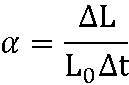
It shows how much a material’s length changes when heated and used for solids.
Volume Expansivity (Coefficient of Volume Expansion) :-Volume expansivity is the change in volume per unit original volume per degree Celsius rise in temperature.

It shows how much a solid, liquid or gas expands in volume when heated.
Related Topics