This Worksheet 18 contains questions based on Chapter 18 Sound and Communication with complete answers.
.png)
This post explains the answers of questions given in the worksheet including
explanation, diagrams. These solutions will help you complete your assignments
and TMA also.
Sound and Communication Worksheet 18 Solution
Q1.While talking directly is the most used form of communication, technology has enabled us to use many other ways like telephone, radio, television, text message, and internet. Is there any difference between the direct communication and technology-based communications
A) If yes, support your answer with reason.
B) If no, support your answer with reason.
Answer
Yes,there is a difference between direct communication and technology-based
communication.
Reason
Indirect communication- We use sound waves to talk face to face. These sound waves are mechanical waves and require medium like air to propagate. This communication is possible when people are close to each other.
In technology -based communication- This communication is done through telephone,radio, television and internet. The voice is converted into electrical signal
and sent as electromagnetic wave (radio waves or microwaves). These waves do
not need any medium like air.
So, this communication is possible over very long distances across countries or
continents.
Q2.Perform an activity to verify that the sound has an association with vibrations? Explain how these vibrations are transmitted in a medium mechanically and how sound travels.
Answer
Activity to show that sound is associated with vibrations
Aim
To demonstrate that sound is produced due to vibrations
Materials Required
1. Metallic hanger or aluminium wire
2. Rubber band or string
3. Piece of paper
Procedure
i. Bend the metallic hanger into a bow shape.
ii. Tie a rubber band or string tightly between the two ends so that it is under tension.
iii. Pluck the stretched string with your finger.
iv. You will hear a sound
v. Now touch the string with your finger after plucking again to observe movement.
Observation
i. Sound is heard when the string is vibrating.
ii. When the string is held, vibrations stops and the sound also stops.
iii. The paper strip moves, showing that the string is vibrating.
Conclusion
This activity proves that sound is produced due to vibrations.
How vibrations are transmitted in a medium and how sound travels
When an object vibrates, it makes the surrounding air particles vibrate. These vibrating air particles push nearby particles and create region of compression (high pressure) and rarefaction (low pressure).
This continuous series of compression and rarefactions moves forward through the
medium.
In this process, energy travels from one point to another. The particles do not
move forward; they only vibrate about their mean positions.
So sound travels through a medium as a mechanical wave. Because sound needs a
medium and vibrating particles.
Q3. Perform an activity to justify that the sound results from vibration and needs a medium to travel (gas/solid/liquid). Out of solid, liquid and gas in which medium sound travels fastest. Justify your answer.
Answer
Activity – Sound is produced due to vibrations
Materials Required
1. Steel tumbler
2. Spoon
Procedure
We strike the steel tumbler with a spoon. We hear a sound. Now we hold the tumbler with our hand.
Observation
When we struck the tumbler, it vibrates and produces sound but when we hold it tightly, vibrations stop and we cannot hear sound.
Conclusion
This activity shows that sound is produced due to vibrations.
Sound needs a medium to travel
Sound travels by vibrating the particles of a medium like air(gas), water(liquid) or
steel(solid). Sound cannot travel in vacuum.
Example: – Sound cannot travel on the moon. This proves that it needs a medium to
propagate.
Medium in which sound travels fastest
Speed of sound in steel ≈5200m/s
Speed of sound in water ≈1520m/s
Speed of sound in air ≈330m/s
We can find from the above examples that Sound travels fastest in solids.
Particles in solids are closely packed so vibrations are transferred quickly from one
particle to another. Particles in liquids and gas are loosely packed. That’s why speed of sound is less than in the solids.
Q4.Perform an activity to verify that a wave transfers energy from one point to the other without the medium particles moving from one point to the other. As we describe our friend by their name, height, colour, gender etc, similarly mention the parameters to describe wave.
Answer
Activity – To show that a wave transfers energy without transferring medium particles
Materials Required
i. Water in tub
ii. Stone
Procedure
We take a tub filled with water and throw a small stone into the water and
observe.
Observation
We see circular ripples move outward from the point where the stone falls. If we
put a small leaf or paper boat on the water, it only oscillates up and down and
does not move to the edge of the tub.
Conclusion
This activity shows that a wave transfers energy and particles of the medium do not
move from one place to another, they only oscillate.
A wave is described by the following parameters-
i. Amplitude
ii. Wave length
iii. Time period
iv. Frequency
v. Wave speed
i. Amplitude – The maximum height of the wave from its mean position. It indicates the loudness of sound.
ii. Wave length – This distance between two successive crests or troughs. It is the distance between two successive compression or rarefactions in longitudinal wave. Its
symbol is lambda (`λ`)
iii. Time period – The time taken by one complete wave to pass a point. It is measured in seconds.
iv. Frequency – The number of complete waves passing a point in one second. It is measured in herts(Hz).
v. Wave speed/velocity– The distance travelled by a wave in one second.
V= frequency ×wavelength
Q5. Continue to Q4, calculate wavelength for the frequences 200HZ and 1000HZ if the velocity of sound is 330m/s. Also comment which sound wave will have its crests farther apart from each other – a wave with frequency 200 Hz or a wave with frequency 1000 Hz? Justify your answer.
Answer
Given values
Velocity= 330 m/s
Frequency (f1) =200Hz
Frequency(f2) = 1000Hz
Velocity=frequency ×wavelength


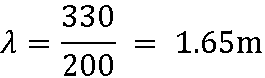
(i) Find wave length for frequency 200Hz
λ=330200
(ii) Wavelength for frequency 1000Hz
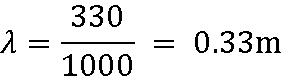
The sound wave with frequency 200Hz has its crests farther apart because wavelength is inversely proportional to frequency for the same velocity.
Since 200 Hz has a larger wavelength (1.65m) compared to 1000Hz(0.33m) so the crests of the 200 Hz wave are farther apart.
At the same speed of sound, the wave with lower frequency has greater wavelength.
Q6. SONAR and RADAR are two techniques which have many applications. Write full abbreviation of SONAR and RADAR. Also mention their elements working and applications.
Answer
SONAR= Sound Navigation And Ranging
RADAR= Radio Detection And Ranging
Elementsof SONAR
Anactive SONAR has two main components:
i. Transmitter – It consists of a signal generator, power amplifier and a transducer. It sends sound waves in water as a narrow beam.
ii. Detector/Receiver – It is a signal detector or an array of detectors. It receives the reflected sound.
Working of SONAR
.webp "NIOS Class 10 Science Working of SONAR")
i. SONAR works on the principle of echo.
ii. Sound waves are sent into water by the transmitter.
iii. When these waves strike an object (submarine, sea bottom) and reflect back.
iv. The receiver detects the reflected waves.
v. Sound travels to the object and back so the distance can be calculated by the following formula

Where
v= velocity of sound in water
t= time between transmission and reception
Applications of SONAR
SONAR is used in
i. Detecting submarines and ships.
ii. Measuring depth of the sea.
iii. Navigation in oceans.
iv. Marine research and defense.
Elements of RADAR
.webp "NIOS Class 10 Science Elements of RADAR")
Following are the basic elements of RADAR
i. Pulse source and transmitter with aerial to generate and sends radio waves.
ii. Object/Target- It reflects the radio wave.
iii. Receiver with antenna and display system- It receives the reflected waves and displays the information like a CRT screen.
Working of RADAR
i. RADAR uses radio waves (electromagnetic waves)
ii. The transmitter sends radio waves into space.
iii. These waves are reflected back when they hit an object.
iv. The receiver detects the weak reflected waves.
v. The time delay between transmission and reception is used to calculate the distance.
vi. RADAR can also detect moving objects using the Doppler effect.
Applications of RADAR
RADAR is used in
i. Air traffic control
ii. Weather forecasting
iii. Ship navigation
iv. Military applications
v. Tracking moving objects like satellites or aeroplanes.
vi. Automatic doors and security systems.
Q7. Though communication need not always be verbal, still verbal communications has importance in day-to-day life of all. There are different modes of communication i.e. writing, facial expression, body language and many more. Write in your own words what is the need and importance of communication.
Answer
Communication is very important in our day-to-day life because our actions depend on the thoughts, needs and expectations of other people.
Communication is not always verbal and can happen through facial expressions or body languages but these methods are not sufficient to understand.
Our thoughts remain in our mind and cannot be known to others unless we communicate.
By communicating, we share ideas, feelings, information and needs with each other.
Verbal communication plays a very important role.
Importance of communication
Communication helps us to
i. Understand each other.
ii. Take correct decisions and actions
iii. Work together in society.
iv. Share knowledge and experiences
In day-to-day life, communication takes place directly through speech and also through instruments like microphones, loudspeakers, telephones, computers, satellites and internet.
Q8. Continue to Q7, observe your surroundings and enlist
a) Different types of communication
b) Different types of communication devices.
Answer
(a) Different types of communication in our surroundings
We can find following types of communication
i. Verbal communication – This is very common form of communication like talking face to face and classroom teaching.
ii. Written communication – This is through words in the form of letters, books, newspapers and notes.
iii. Non – verbal communication – This is without words and through facial expression, gestures, body language.
iv. Sound based communication- This communication is done by instruments like
microphones, loudspeaker and phones.
v. Electronic /technology-based communication – This type of communication is done using electrical and electromagnetic signals. Telephones, radio, television, internet are the examples.
(b) Different types of communication devices
The following devices are mostly used in communication
i. Microphone – It converts sound into electrical signals.
ii. Loudspeakers/ speakers – It converts electrical signals back into sound.
iii. Telephone- It allows two-way voice communication.
iv. Mobile phone- This is wireless communication using electromagnetic waves.
v. Radio – This is one way communication device.
vi. Television – This is audio-visual communication device.
vii. Computer – It is used for e-mail, internet calls and messaging.
viii. Internet – It enables instant communication across the world
ix. Satellite – It helps in long distance communication and broadcasting.
x. HAM radio – It is used for wireless communication during disasters
Q9. The inventions of microphone, speakers, telephone, satellite, computer and internet have revolutionized communication. The basic working principle remains the same in all communication devices. Explain basic working principle of communication devices.
Answer
The basic working principle of all communication devices is common.
.webp "NIOS Class 10 Science basic working principle of all communication devices") i. First the sound produced by a person causes vibration in air. These sound waves are received by a microphone which converts sound waves into electrical signals.
i. First the sound produced by a person causes vibration in air. These sound waves are received by a microphone which converts sound waves into electrical signals.
ii. These electrical signals are transmitted over long distances. The signals travel through metallic or optical cables in wired communication. In wireless communication, the electrical signals are converted into electromagnetic waves and sent through space using antennas, satellites or towers.
iii. These transmitted signals are received by a receiver. The speaker converts these signals into sound waves again and the listener hears the same sound
Q10. Observe different musical instruments i.e. Flute, tabla , drum, guitar, piano, harmonium, bells, manjeera, ghungroo, chimta etc in your surroundings which produce sounds. You will observe that different instruments will produce different sounds. Explain the phenomenon why different instruments produce different sounds. Also comment what is the basic difference between noise and music?
Answer
Different musical instruments produce different sounds
Different musical instruments produce different sounds because the vibrations produced by them are different in nature. Each instrument has a different structure, size, shape and method of producing sound which affects the vibrations.
Instrument like table, drum and bells produce sound due to vibration of a stretched membrane or metal body.
Instrument like guitar, piano produce sound due to vibration of strings.
Instruments like flute and harmonium produce sound due to vibration of air
The sound produced by an instrument depends on frequency of vibration, amplitude of vibration and wave form or quality.
Difference between Noise and Music
|
Noise |
Music |
|
It is unpleasant and unwanted sound |
It is a pleasant and soothing sound |
|
Produced by irregular vibrations |
Produced by regular and periodic vibrations |
|
Causes discomfort and disturbance |
Gives pleasure and relaxation |
|
Example-traffic noise, loud horns |
Example- song , instrumental music |
Related Topics
1). NIOS Class 10 Science Worksheets Solutions Set 1