This worksheet contains questions based on motion and its types, distance, displacement, speed and velocity
This post explains the answers of questions given in the worksheet including
explanation, diagrams. These solutions will help you complete your assignments and TMA also.

NIOS Class 10 Science (212) Worksheet 9 Solutions
Q1. In your surroundings, you will observe that some things are in motion while others are at rest. Make a list of things which are in motion. Based on your observations; explain the concept of motion and distinguish between rest and motion.
Examples of things in motion
1. Moving car on road
2. A flying bird
3. Flowing water in the river
4. A rotating fan
5. A running boy
Examples of things at rest
1. A building
2. A tree
3. A book lying on the table
4. A chair in the room
5. An electric pole
Concept of motion
An object is said to be in motion if its position changes with respect to a fixed point in a given time.
An object is said to be at rest if its position does not change
Differences between motion and rest
|
Motion |
Rest |
|
An object in motion if it changes its position with respect to a fixed point in |
An object at rest if it does not change its position with respect to a fixed |
Conclusion: Motion and rest are relative terms. An object may appear to be at rest with respect to one observer but in motion with respect to another.
Q2. Continue to Q1, further observe that all the things which are in motion have similar motion or not.
(a) If yes, support your answer with reasons.
(b) If no, explain different types of motions with examples from day-to-day life.
Answer
No, all things in motion do not have similar motion. Different objects move in
different ways depending on path, direction and speed.
Example: – A car move in straight line; fan rotates around its axis and a pendulum swing to and fro.
Types of motions
1. Rectilinear motion
2. Circular motion
3. Oscillatory motion
4. Rotational motion
5. Random motion
1. Rectilinear motion: Motion along a straight path is known as rectilinear motion. Example – motion of train or car.
2. Circular motion: Motion in a circular path is known as circular motion. Example-
rotation of fan, motion of moon around the earth.
3. Oscillatory motion: A repeated motion to and fro about a fixed point is called oscillatory motion. Example- motion of pendulum, a child on a swing.
4. Rotational motion: The motion of an object about its own axis is called rotational motion. Example – Rotation of earth. Spinning top.
5. Random motion: This type of motion does not follow a particular path. Example-
movement of flies or insects
So, these are the different types of motion.
Q3. Provide examples of different types of motion from your surroundings.
Answer
We have already learnt different types of motion in the previous question.
Following are the examples of these motion-
1. Rectilinear motion – Car moving on road, a person walking along straight path, arrow shot from a bow.
2. Circular motion- motion of merry-go-round, blades of ceiling fan, whirling of stone tied to a string.
3. Oscillatory motion – Movement of pendulum of clock, vibration of tuning fork
4. Rotational motion- Earth’s rotation on its axis, spinning top.
5. Random motion- Movement of particles in the air, movement of fish in water,
Q4. You started moving from your home at 9:00 am on a straight road and reached market 5 km away. Stayed there for approx. 2 hours and returned back to home. While returning you took a different root which is shorter than before i.e. 3.8km. Represent graphically Distance and displacement travelled by you during your visit. Differentiate between distance and displacement.
Answer
.webp)
Difference between distance and displacement
|
Distance |
Displacement |
|
Total path covered by an object |
Shortest straight-line distance between initial and final points |
|
Scalar quantity |
Vector quantity |
|
Always positive |
Positive, negative or zero |
Q5. Different types of motions are represented graphically as given below. Identify and explain following figures representing different motions of a moving object correctly.

Answer
These are the distance -time graph which represent the motion of an object. These
graphs show different types of motions
1. Graph a -In this graph a straight line with a positive slope. The distance increases uniformly with time. The object moves in straight line at a constant speed so the graph represents uniform motion.
2. Graph b – In this graph, a curve gets steeper with time. The distance increases more rapidly as time passes, the graph represents accelerated motion.
3. Graph c- In this graph, a curve goes flat over time. The distance increases first but
then slow down with time. The object slows down. This graph represents decelerated motion.
4. Graph d- In this graph a horizontal straight line which shows distance remains constant over time, it means the object at rest. There is no motion.
Q6. Observe moving things in your surroundings and estimate their speed/velocity. Give explanation how does velocity differ from speed? Support your answer why velocity is a vector quantity, but not speed.
Answer
Moving things and their speed/velocity
1. A car travels at 40km/h. The velocity depends on direction e.g. 40 km/h east.
2. Bicycle travels at 15 km/ h north.
3. Airplane travels at 800 km/h towards Delhi.
Difference between Speed and velocity
|
|
Speed |
Velocity |
|
Definition |
Distance covered per unit time |
Displacement covered per unit time in specific direction |
|
Formula |
Speed= |
Velocity |
|
Type |
Scalar quantity |
Vector quantity |
|
Example |
A car is moving 60 km/h |
A car is moving 60 km/h east. |
Why velocity is a vector quantity but speed is not
Velocity has both magnitude and direction so it a vector quantity but speed has only
magnitude so it is scalar quantity.
Q7. If you and your friend ride a bicycle on the road, you will notice that at different times, the both bicycles are found at different positions. Note down five positions at five times interval for each
a). Plot position Time Graph for Uniform Motion
b) Plot Position Time Graph for Non- Uniform Motion
c)Calculate Velocity from Position Time Graph.
d) Calculate Distance travelled by you and your friend in 10 minutes.
e) Examine whose speed is more?
Answer
Suppose you and your friend ride bicycles. Different positions are given at different
time.
|
Time(min) |
Your |
Friend’s |
|
0 |
0 |
0 |
|
2 |
100 |
90 |
|
4 |
200 |
180 |
|
6 |
300 |
270 |
|
8 |
400 |
260 |
|
10 |
500 |
450 |
This table shows uniform motion.
a). Plot position Time Graph for Uniform Motion

b) Plot Position Time Graph for Non- Uniform Motion

c)Calculate Velocity from Position Time Graph.
Calculate velocity from graph
Velocity = slope of position -time graph
For uniform motion- slope is constant
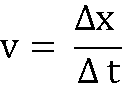
For you

For your friend

For non-uniform motion, velocity changes at each interval
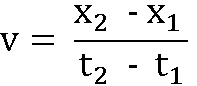
d) Calculate Distance travelled by you and your friend in 10 minutes.
Uniform motion
You = 500 m
Your friend =450m
Non- uniform motion – sum of individual segments
You- 0→80→190→310→450→500
Distance = 80 +110 + 120 +140 +50 =500m
Your friend –
0→70→160→250→380→450
Distance = 70 +90 + 90 +130 +70 =450m
e) Examine whose speed is more

You

Your friend

You are faster than your friend
Q8. The velocity-time graph below shows the motion of a man. Calculate –
a) The distance covered by the cyclist in 20 second and 25 seconds.
b) Its velocity
c) Its acceleration
Answer
Velocity of man = 20m/s
Time interval= upto 25s
(a) Distance covered
Distanced covered = Area under the velocity- time graph
Since it is a rectangle (constant velocity)
Distance = Velocity ×Time
In 20 second
d= 20 ×20 =400m
In 25 seconds
d= 20 ×25=500m
(b) Velocity
20m/s (constant) from the graph
(c) Acceleration

Final velocity = 20m/s
Initial velocity= 20m/s
Change in velocity = final velocity – initial velocity
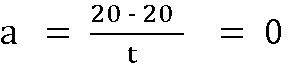
A = 0m/s
Motion is uniform so there is no change in speed.
Q9.Derive/explain different equations of motion.
Answer
Derivation of equations of motion
Consider,an object moving with uniform acceleration ‘ a’
Let
Initial velocity = u
Final velocity =v (after time t)
Displacement = s
Time =t
There is certain relationship between these quantities
First Equation of Motion
We know that
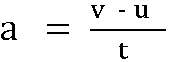
So v =u +at ……9.1
This is called first equation of motion.
Second Equation of Motion
We also know that
Displacement = (Average velocity) × (Time interval)

We substitute v=u+at from equation 9.1
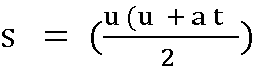
Simplifying
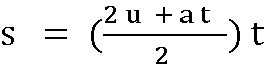
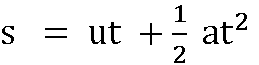 ……..9.2
This is called second equation of motion
If the object starts from rest (u=0)

So we see that the displacement of an object undergoing constant acceleration is proportional to t2, while an object with constant velocity, displacement is proportional to t.
Third Equation of Motion
We know that
and
Now we multiply these two equations

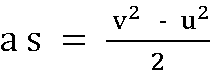
Now we multiply both sides by 2

 ………. 9.3
This is third equation of motion
Q10. A boy starting from rest travels 40 m in first 4 s and 200 m in next 6 s. what will be the velocity after 7 s from the start.
Answer
Given values
U= 0 m/s
Displacement in first 4 s = s1= 40m
Displacement in next 6 s = s2 =200m
Find acceleration in first 4 s
s1=u1t1+ 12at12

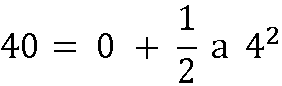

Velocity after 4 s

= 0 + 5 × 4 = 20m/s
Acceleration in next 6s


200= 120+18a2
a2 =4.44m/s2
Velocity after 7s
After 4s , in next 3s
v=u2+a2 t
20+ 4.44×3 = 33.3m/s
NIOS Class 10 Science Worksheet Solutions
|
Worksheets |