In this post you will find answers of questions of Worksheet -3 NIOS class 10
science (Code-212) Chapter 3- Atoms and Molecules with complete explanation.

Atoms and Molecule Worksheet 3 Answers
Q1. Pure water contains 11.11% of hydrogen and 88.89% of oxygen by mass. What will be the composition of compounds such as ammonia, carbon dioxide, sodium chloride and hydrogen sulphide.

Percentage of elements by mass in Ammonia
Mass of nitrogen (N)=14
Mass of hydrogen (H)= 1 ×3 =3
Total mass 17g/mol


Percentage of elements by mass in CO2
Mass of Carbon (C) = 12
Mass of oxygen (O) = 16 ×2 =32
Total mass = 44g/mol


Percentage of elements by mass in NaCl
Mass of sodium (Na) = 23
Mass of chlorine (Cl) =35.5
Total mass =58.5g/mol


Percentage of elements by mass in H2S
Mass of hydrogen (H)= 1×2 =2
Mass of sulphur (S) = 32
Total mass = 34g/mol


Q2. Analyse if everything is made of atoms. How could scientists be sure that there was not anything smaller than an atom? Explain by using your knowledge of chemistry.
Answer
Everything is made up of atoms
Yes, all matter (solid, liquid and gas) is made up of tiny particles called atoms. According to Dalton’s atomic theory-
Atom is the smallest particle and is basic building block of matter.
Scientists thought atoms were indivisible
The word ‘Atom’ comes from Greek word ‘ Atomos’ which means indivisible.
John Dalton proposed atomic theory:
1. Atoms are the smallest indivisible particles.
2. They cannot be created or destroyed in chemical reaction.
Discovery of smaller particles than atoms
J.J. Thomson discovered electrons and Rutherford discovered positively charged
particles in the nucleus of atom. James Chadwik discovered neutrons in the nucleus.
Q3. Atoms were thought to be indivisible, later as per studies, we know that they are made of smaller particles, can we still consider them as building blocks of matter. Give reasons in support of your answer.
Answer
Yes, atoms are still considered the basic building blocks of matter. We know atoms
are divisible and made-up smaller particles – electrons, protons and neutrons.
Reasons
1. Atoms are divisible into subatomic particles but these particles cannot take part in
chemical reaction and does not show chemical properties.
2. Atoms combine in fixed ratio to form molecules but subatomic particles cannot do.
3. Structure of substance (solid, liquid and gas) depends upon arrangement of atoms.
So,atoms are divisible into smaller subatomic particles but they are fundamental
units of matter.
Q4. Nitrogen and hydrogen combine in the ratio 14:3 by mass of form ammonia molecule. Find the formulae of ammonia molecule by calculating the molar ratio?
Answer
Mass ratio of Nitrogen: Hydrogen =14:3
Atomic mass of Nitrogen = 14u
Atomic mass of Hydrogen = 1u
Moles of each element
Moles= Mass givenAtomic mass
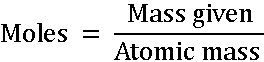


Molarratio
Nitrogen : Hydrogen = 1:3
Chemical formula of ammonia
1atom of nitrogen and 3 atoms of hydrogen combines to form 1 molecule of ammonia (NH3)
Q5.C6H12O6 is the formula for Glucose. What information do you get from this formula?
Answer
We can get following information through the chemical formula(here C6H12O6):
(i) Elements present: Glucose is made up of carbon(C), Hydrogen(H) and oxygen(O) atoms.
(ii) Number of atoms of each element: In glucose , carbon has 6 atoms, hydrogen has 12 atoms and oxygen has 6 atoms.
(iii) Molecular composition: Atoms are combined in fixed ration 6:12:6 or 1:2:1
(iv) Molar mass of glucose:
Carbon = 12 × 6=72 g
Hydrogen = 1 ×12=12 g
Oxygen = 16 × 6 =96 g
Total mass = 72 + 12+ 96 =180g/mol
(v) Nature of compound: Glucose is an organic compound and it is a primary source of energy in living beings.
So, a formula provide the above information about a substance.
Q6. As we know our body constituted approximately 80% of water. Calculate the number of water molecules which are present in the body of a young person whose weight is 62 kg.
Answer
Mass of water in the body
Mass of water = 80% of total mass of the body

Convert kg to grams
49.6 kg= 49600g
Find moles of water
Molar mass of water = 18g/mol


Calculate number of molecules
Avogadro’s number (NA) = 6.022 × 10²³ molecules/mol
Number of molecules = moles× NA
= 2755.56× 6.022 × 1023
= 1.66 ×1027 molecules
So, 1.66 ×1027 water molecules which are present in the body of a young person whose weight is 62 kg.
Q7. Calculate the molecular mass of the following compounds: MgO. CaO, NH3, H2SO4.
Answer
1.Molecular mass of Magnesium oxide (MgO)
Mg= 24.3u
O = 16u
Molecular mass = 24.3+ 16 = 40.3 u
2.Molecular mass of Calcium oxide (CaO)
Ca= 40.1 u
O= 16 u
Molecular mass = 40.1+ 16 = 56.1 u
3. Molecular mass of Ammonia (NH3)
N= 14 u
H = 1× 3 =3u
Molecular mass = 14 + 3 = 17u
4. Molecular mass of Sulphuric Acid (H2SO4)
H= 1 ×2 = 2u
S= 32.1u
O = 16 ×4 =64
Molecular mass = 2 + 32.1 + 64 = 98.1u
|
Compound |
Molecular mass |
|
MgO |
40.3 u |
|
CaO |
56.1 u |
|
NH3 |
17u |
|
H2SO4 |
98.1 u |
Q8. These are different forms of oxygen ie 2O, O2 and O3. What is the difference between 2O, O2 and O3.
Answer
|
Features |
2 O |
O2 |
O3 |
|
Composition |
2 separate atoms |
Two atoms bonded |
Three atoms bonded |
|
Stability |
Extremely |
High |
Moderate |
|
Reactivity |
High |
Moderate |
Very high |
|
Occurrence |
Upper atmosphere |
Everywhere |
Ozone layer |
|
Role |
Initial radical chemistry |
Respiration, combustion |
UV absorption |
Q9.Atomic number of uranium is 92. If uranium has three isotopes having 141, 143 and 145 neutrons in their nucleus. How would they be the symbol of the isotopes? How does isotopes different form isobars?
Answer
Find mass number of isotopes
Mass number (A)= Number of protons(Z) + Number of neutrons(N)
Since uranium’s atomic number id 92
Isotope 1: mass number = 92 +141=233
Isotope 2: mass number = 92+143 =235
Isotope 3: mass number = 92 +145 =237
Symbols of isotopes
 ,
,  ,
,
Difference between isotopes and isobars
|
Isotopes |
Isobars |
|
Atoms of same elements having similar atomic number but different mass numbers |
Atoms of different elements having same mass number but different atomic numbers. |
| , ,
|
 , ,  |
Q10.“A sample of a pure substance always consists of the same elements combined in the same proportion by mass”. Which law has proposed this? Explain the law in details.
Answer
This is the Law of constant Proportion (law of definite proportion)
This law was proposed by Joseph Proust. According to this law ‘ If a compound is
pure, the mass ratio of its constituent elements remains constant.’
Example– H2O
Mass of hydrogen =1×2=2g
Massof oxygen = 16g
Ration by mass = 2 : 16 or 1:8
This ration is always 1:8, whether water is from rain, river or sea.
NIOS Class 10 Science Worksheet Solutions
|
Worksheets |