This chapter is from Module 2 Matter in Our Surroundings. This post provides you complete answer of all intext and terminal questions given in Chapter 3 Atoms and Molecules

Our experienced teachers have provided easy and accurate answers to all questions that will help you complete your assignments.
Atoms and Molecules -Overview
The chapter explains the fundamental concepts of matter’s building blocks ‘atoms’. The chapter discusses two important laws- the law of conservation of mass and the law of constant proportions.
Intext Questions 3.1 with Answers
Q1. Name the scientists who proposed the law of conservation of mass and law of constant proportion.
Answer
(i) Law of conservation of mass – Antoine Lavoisier
(ii) Law of constant proportion – Joseph Proust
Q2. 12 g of magnesium powder was ignited in a container having 20g of pure oxygen. After the reaction was over, it was found that 12 g of oxygen was left unreacted. Show that it is according to laws of constant proportion
2Mg+ O2 →2MgO
Answer
Given
Mass of magnesium(Mg)= 12g
Mass of oxygen (O 2)= 20 g
Mass of oxygen unreacted = 12g
Therefore mass of oxygen reacted = 20g- 12g = 8g
The balanced chemical equation is
2Mg+ O2 →2MgO
According to the equation
2 atoms of Mg(2×24 g) react with 1 molecule of O2 (32g)
This mean 48g of Mg reacts with 32g of O2 in 3:2 ratio
Now in the given reaction
Mg:O2
12g : 8g
Since the ration of masses of Mg and O2 is constant, so the reaction obeys the ‘Law of constant Proportion’
Intext Questions 3.2 with Answers
Q1. Nitrogen forms three oxides: `NO, NO2 . N 2O 3. Show that it obeys law of multiple proportion.
Answer
The law of multiple proportion states that if two elements combine to form more than one compound, mass of one element that combines with fixed mass of other element in simple whole number ratio.
In NO, the mass ration of nitrogen to oxygen is 14:16 (7 : 8)
In NO2 , the mass ration of nitrogen to oxygen is 14:32 (7 : 16)
In N2O3, the mass ration of nitrogen to oxygen is 28:48 (7 :12)
Comparing the masses of oxygen for fixed mass of nitrogen 8,16 and 12 are in the simple ratio of 2 :4:3 This confirms that nitrogen and oxygen obey the law of multiple proportion.
Q2. Atomic number of silicon is 14. If there are three isotopes of silicon having 14,15 and 16 neutrons in their nuclei, what would be the symbol of the isotopes.
Answer
Atomic number of silicon is 14
Isotope with 14 neutrons
Mass number = 14 +14 =28

Isotope with 15 neutrons
Mass number 14 + 15= 29

Isotope with 16 neutrons
Mass number 14 +16 =30

Q3. Calculate molecular mass of the compounds whose formulas are provided below- C2H4 , H2O and CH3OH.
Answer
(i) Molecular mass of C2H4
Mass of two atoms of carbon + mass of 4 atoms of hydrogen
2× 12u + 4 × 1u= 28u
(ii) Molecular mass of H2O
Mass of two atoms of hydrogen + mass of 1 atom of oxygen
2× 1u + 1 × 16u= 18u
(iii) Molecular mass of CH3OH
Mass of 1 atom of carbon+ mass of 4 atoms of hydrogen + mass of 1 atom of oxygen
1× 12u + 4 × 1u +1 × 16u = 32u
Intext Questions 3.3 with Answers
Q1. Work out a relationship between number of molecules and mole.
Answer
The relationship between the number of molecules and the mole is defined by Avogadro’s constant, which is 6.022 ×10²³.
One mole of any substance contains exactly6.022 ×1023 molecules (ions, atoms,)
Number of molecules = Number of moles × 6.022 ×10²³
Q2. What is molecular mass? In what way it is different form the molar mass?
Answer
Molecular mass – It is the sum of the atomic masses of all the atoms in a molecule.it is expressed in atomic mass unit.
Molar mass – It is mass of one mole of substance (atoms, molecule, ions) and is expressed in gram per mol.
For example – The molecular mass of water is 18u and molar mass is 18 g/mol.
Q3. Consider the reaction
C(s) + O2(g) →CO2(g)
18 g of carbon was burnt in oxygen. How many moles of CO2 is produced?
Answer
The balanced chemical equation is
C(s) + O2(g) → CO2(g)
1 mol (12g) 1 mol(32g) 1 mol(44g)
Molar mass of C= 12g
Moles of carbon used = 18g/12g/mol =1.5mol
According to the equation 1 mole of carbon produces 1 mole of `CO_2`
Therefore 1.5 mole carbon produces 1.5 moles of `CO_2`
Q4. What is the molar mass of NaCl?
Answer
Atomic mass of Na = 23g/mol
Atomic mass of Cl= 35.5g/mol
So molar mass of NaCl= 23 + 35.5 =58.5 g/mol
Intext Questions 3.4 with Answers
Q1. Write the name of the expected compound formed between
(i) Hydrogen and sulphur
(ii) Nitrogen and hydrogen
(iii) Magnesium and oxygen
Answer
(i) Hydrogen sulphide (H2S)
(ii) Ammonia (NH3)
(iii) Magnesium oxide (MgO)
Q2. Propose the formulas and names of the compound formed between
(i) Potassium and iodide ions
(ii) Sodium and sulphate ions
(iii) Aluminium and chloride ions
Answer
(i) KI (Potassium iodide)
(ii) Na 2SO4 (Sodium sulphate)
(iii) AlCl3 (Aluminium chloride)
Q3. Write the formula of the compound formed between
(i) Hg2+ and Cl–
(ii) Pb2+ and PO43-
(iii) Ba2+ and SO42-
Answer
(i) HgCl2
(ii) Pb3(PO 4)2
(iii) BaSO4
Terminal Exercise with Answers
Q1. Describe the following:
(i) Law of conservation of mass
(ii) Law of constant proportions
(iii) Law of multiple proportions
Answer
(i) Law of conservation of mass – According to this law, mass can neither be created nor destroyed in a chemical reaction. The total mass of the reactants is always equal to the total mass of the products. This law was proposed by Antine Lavoiser.
(ii) Law of constant proportion -A chemical compound always contains the same elements in the same fixed proportion by mass. This law was proposed by Joseph Proust.
(iii) Law of multiple proportions – If two elements combines to form more than one compound, then the masses of one element that combine with a fixed mass of the other are in the ration of small whole numbers. This law was proposed by John Dalton.
Q2. What is the atomic theory proposed by John Dalton? What changes have taken place in the theory during the last two centuries?
Answer
Dalton’s atomic theory
1.All matter is made up of indivisible particles called atoms.
2.All atoms of given element are identical in mass and other properties.
3.Atoms cannot be created or destroyed in a chemical reaction.
4.Atoms of different
elements combine in fixed and simple ratio to form compounds.
5.Chemical reactions involve the rearrangement of atoms.
Modifications to Dalton’s theory
1. Atoms are made up of subatomic particles- protons, electrons and neutrons.
2.Atoms of the same element can have different masses. Ex- isotopes.
3.Atoms can be transformed in nuclear
reactions.
Q3. Write the number of protons, neutrons and electrons in each of the following isotopes
 ,
,  ,
,  ,
, 
Answer
|
isotopes |
Atomic number(Z) |
Mass number(A) |
protons |
neutrons |
Electrons |
|
|
1 |
2 |
1 |
1 |
1 |
|
|
8 |
18 |
8 |
10 |
8 |
|
|
9 |
19 |
9 |
10 |
9 |
|
|
20 |
40 |
20 |
20 |
20 |
Q4. Boron has two isotopes with masses 10.13 u and 11.01 u and abundance of 19.77% and 80.23% respectively. What is the average atomic mass of boron?
Answer
Given
Isotope 1
Mass = 10.13u, abundance = 19.77%
Isotope 2
Mass= 11.01 u , abundance = 80.23%


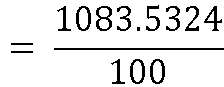
= 10.83u
Q5. Give symbol for each of the following isotopes
(i) Atomic number 19, mass number 40
(ii) Atomic number 7, mass number 15
(iii) Atomic number 18, mass number 40
(iv) Atomic number 17, mass number 37
Answer
(i) 
(ii) 
(iii) 
(iv) 
Q6. How does an element differ from a compound? Explain with suitable examples.
Answer
|
S.N. |
Element |
Compound |
|
1 |
An element is |
Compound is made up two or more elements in fixed ratio. |
|
2 |
It cannot be Examples – H , O |
It cab be broken Examples – CO2, H2O |
Q7. Charge on one electron is 1.6022 × 10⁻¹⁹. What is the total charge on 1 mol of electrons?
Answer
Given
Charge on one electron = 1.6022 × 10⁻¹⁹
Numbers of electrons in one mole = 6.022 × 10²³
Total charge = charge on one electron × number of electrons in 1 mole
= 1.6022 × 10-19 × 6.022 × 1023
= 96485 Coulombs
Q8. How many molecules of `O_2` are in 8.0g of oxygen? If the `O_2` molecules were completely split into O(oxygen atoms), how many moles of atoms of oxygen would be obtained?
Answer
Calculate number of moles of O2 in 8.0g
Molar mass of O2 =32g/mol
Moles of O 2= 8.0g/32g/mol =0.25mol
Calculate number of molecules of O2
Use Avogadro’s number =6.022× 10²³
Number of `O_2` molecules= 0.25 × 6.022× 1023 =1.506 × 10²³
If O2 splits into O atoms
Moles of O atoms = 0.25 × 2= 0.5 mol
Q9. Assume that human body is 80% water. Calculate the number of molecules of water that are present in the body of a person whose weight is 65kg.
Answer
Find the mass of water in the body
If the human body is80% water , then for a person weighing 65 kg
Mass of water = 80% of 65kg= 0.80× 65 =52 kg= 52000g
Calculate moles of water
Molar mass of water = 18g/mol

Calculate number of water molecules
1 mol= 6.022× 10²³ molecule
Number of molecules =2888.89×6.022× 1023 ≈1.739×1027
So approximately 1.74 × 1027 molecules of water are present in the body of a 65 kg person
Q10. Refer to atomic masses given in the Table 3.2 of this chapter. Calculate the molar masses of each of the following compound
HCl, NH3, CH4 , CO and NaCl
Answer
Atomic masse of elements given in the table 3.2
Hydrogen =1u
Chlorine = 35.5 u
Nitrogen = 14u
Carbon = 12u
Oxygen =16 u
Sodium = 23 u
Molar mass of HCl
= H(1) + Cl(35.5) = 36.5 g/mol
Molar mass of NH3
= N(14)+3 ×H(1) = 17g/mol
Molar mass of CH4
= C(12) + 4× H(1) = 16g/mol
Molar mass of CO
= C(12) + O(16)= 28g/mol
Molar mass of NaCl
= Na(23) +Cl(35.5) =58.5 g/mol
Q11. Average atomic mass of carbon is 12.01u. Find the number of moles of carbon is (a) 2.0g of carbon (b) 8.0 g of carbon
Answer
Given
Average atomic mass of C= 12.01 u

For 2.0 g of carbon
Mole of carbon

For 8.0 g of carbon

Q12. Classify the following molecules as di, tri, tetra, penta and hexa atomic molecules : H2 , P4 , SF4 , SO2 , PCl3 , CH 3OH , PCl5 , HCl
Answer
|
Molecule |
Number of atoms |
Atomic form of |
|
H2 |
2 atoms |
Di atomic |
|
P4 |
4 atoms |
Tetra atomic |
|
SF4 |
5 atoms |
Penta atomic |
|
SO2 |
3 atoms |
Tri atomic |
|
PCl3 |
4 atoms |
Tetra atomic |
|
CH3OH |
6 atoms |
Hexa atomic |
|
PCl5 |
6 atoms |
Hexa atomic |
|
HCl |
2 atoms |
Di atomic |
Q13. What is the mass of
(a) 6.02 × 10 23 atoms of oxygen
(b) 6.02 × 10 23 molecules of `P_4`
(c) 3.01 × 10 23 molecules of `O_2`
Answer
(a) 6.02 × 10 23 atoms of oxygen
Molar mass of 1 oxygen atom =16g
Number of atoms of oxygen in 1 mole = 6.02 × 10 23
So the mass of 6.02 × 10 23 atoms of oxygen = 16 g
(b) 6.02 × 10²³ molecules of `P_4`
Molar mass of P4= 4 × 31 = 124g
Number of atoms of P4 in 1 mole = 6.02 × 10 23
So , the mass of 6.02 × 10²³ molecules of P4= 124 g
(c) 3.01 × 10 23 molecules of `O_2`
Molar mass of O2= 32g
Number of atoms of oxygen in 1 mole = 6.02 × 10 23
Mass of 6.02 × 10 23 molecules of O2 = 32g
Mass of (c) 3.01 × 10²³ molecules of O2 = 16g
Q 14. How many atoms are present in:
(a) 0.1 mole of sulphur
(b) 18 g of water
(c) 0.44 g of carbon dioxide
Answer
(a) 0.1 mole of sulphur atoms
Number of atoms in 1 mole of sulphur = 6.022 × 10²³
Number of atoms in 0.1 mole of sulphur = 6.022 × 1023 ×0.1 = 6.022 × 10²²
So, 6.022 × 10²² atoms in 0.1 mole of sulphur
(b) 18 g of water
Molar mass of water = 18g
So 18 g = 1 mole of water molecules
1 mole of water contains 6.022 × 10²³ molecules
Water is a compound so it contains 6.022 × 10²³ molecules in 18 g of `H_2O`
(c) 0.44 g of carbon dioxide
Molar mass of CO2 = 44g
Number of molecules in 44 g= 6.022 × 10²³
Number of molecules in 0.44 g= 

CO 2 is a compound so, number of CO2 molecules in 0.44g is 6.02 × 10²¹
Q 15. Write various postulates of Dalton’s atomic theory.
Answer
1. All matter is made up of indivisible particles called atoms.
2. All atoms of given element are identical in mass and other properties.
3. Atoms cannot be created or destroyed in a chemical reaction.
4. Atoms of different elements combine in fixed and simple ratio to form compounds.
5.Chemical reactions involve the rearrangement of atoms.
Q16. Convert into mole;
(a) 16 g of oxygen gas(`O_2`)
(b) 36 g of water (`H_2O`)
(c) 22 g of carbon dioxide (`CO_2`)
Answer
We will use the following formula

(a) 16 g of oxygen gas(O2)
Molar mass of O 2= 32g/mol

(b) 36 g of water
Molar mass of water = 18 g/mol
Mole of water in 36 g= 36 18 =2 mole

(c) 22 g of carbon dioxide
Molar mass of CO 2= 44g/mol

Q17. What does a chemical formula of a compound represent?
Answer
A chemical formula of a compound represents the types and numbers of atoms of each element present in one molecule of the compound. It also provides following information
1. Elements present in a compound
2. Ratio of atoms of different elements
3. Total number of atoms
Q18. Write chemical formulas of the following compounds:
(a) Copper(II) sulphate
(b) Calciumfluoride
(c) Aluminium bromide
(d) Zinc sulphate
(e) Ammonium sulphate
Answer
(a) CuSO4
(b) CaF2
(c) AlBr3
(d) ZnSO4
(e) (NH4)2SO4
NIOS Class 10 Science and Technology Solutions(212)
|
Chapter |
Chapter Name |
|
1 |
|
|
2 |
|
|
3 |
|
|
4 |
|
|
5 |
|
|
6 |
|
|
7 |
|
|
8 |
|
|
9 |
|
|
10 |
|
Related Topics