This activity has been taken form the chapter 2 Acids, Bases and salts class 10 science of NCERT science book.
.webp "Activity 2.5 Class 10 Science") |
| Activity 2.5 Class 10 Science |
How do Metal Carbonates and Metal Hydrogen carbonates React with Acids
Aim of the activity
To observe the reaction of metal carbonates and metal hydrogen carbonates with acids and test for the evolving gas.
Materials used in the activity
1. Test tubes
2. 0.5 g sodium carbonate and 05 g sodium hydrogen carbonate
3. Dilute Hydrochloric acid (HCl)
4. Lime water solution (Calcium hydroxide)
Procedure
We will take two tests tubes, label them as A and B and take about 0.5 g of sodium carbonate (Na2CO3) in test A and about 0.5 g of sodium hydrogen carbonate (NaHCO3) in test tube B.
Now we add about 2 ml of dilute HCI to both the test tubes. After some time , we pass the gas produced in each case through lime water (calcium hydroxide solution).
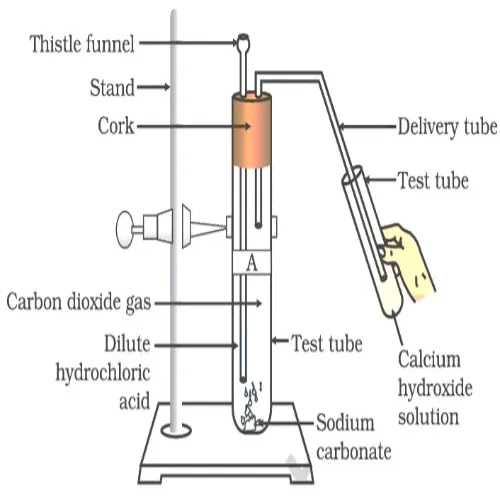 |
| Reaction of metal carbonates and metal hydrogen carbonates with acids |
Observation
In the test tube A
The reaction is vigorous. A brisk effervescence can be seen in the test tube and bubbles are produced that indicate the evolution of a gas.
In the test tube B
The reaction is less vigorous but effervescence can also be seen.
On passing the gas produced in each case through lime water with the help of delivery tube. Lime water turns milky. When the gas is passed in excess, calcium hydrogen
carbonate is formed and turns milkiness.
CaCO3(s) + CO2(g) → H2O(I) → Ca(HCO3)2(aq)
Explanation
In the test tube A
Sodium carbonate reacts with dilute hydrochloric acid to produce carbon di oxide, water and sodium chloride.
Na2CO3 + 2HCl →2NaCl+ H2O +CO2
In test tube B
Sodium hydrogen carbonate reacts with dilute hydrochloric acid to form carbon dioxide, water, and sodium chloride
NaHCO3 +HCl →NaCl+ H2O +CO2
We can see the products formed in the both reactionsare similar but the speed of the reaction in the both test tube is different. The reaction is more vigorous in the test tube A than in the test tube B Sodium carbonate is more reactive than sodium hydrogen carbonate.
Test for the evolving gas
When the gas produced in the both reactions , is passed in lime water, the lime water turns milky. An insoluble substane calcium carbonate is formed.
Ca(OH)2(aq) + CO2(g) → CaCO3(s) + H2O(I)
Lime water milky
This indicates the gas produced is carbon dioxide.
When excess CO2 is passed in lime water, calcium hydrogen carbonate is formed which is soluble in water.
Conclusion
All acids decompose metal carbonates and metal hydrogen carbonates with the liberation of CO2 gas, water and corresponding salt.
Frequently Asked Questions
1. Why does lime water turn milky when carbon di oxide gas is passed through it?
When CO2 is passed through lime water (Ca(OH)2), an insoluble salt calcium carbonate is formed so lime water turns milky.
2. What happen if excess CO2 is passed through lime water?
When excess CO2 is passed through this solution,
calcium carbonate reacts with more CO2 to form soluble calcium hydrogen carbonate.
CaCO3 + CO2 +H2O →Ca(HCO3)2
3. Can we use other acids in this activity2.5?
Yes, we can use other acids like sulphuric acids, nitric acids also.
4. What is the difference between the reactions of Na2CO3 and NaHCO3 with HCl?
In both reactions, HCl reacts with both salts produces CO2 but two moles of HCl are required
with sodium carbonate and only one mole of HCl is required with sodium hydrogen
carbonate.
All Activities Acids , Bases and Salts
| S.No. | Topics |
| 1 | Activity 2.1 |
| 2 | Activity 2.2 |
| 3 | Activity 2.3 |
| 4 | Activity 2.4 |
| 5 | Activity 2.5 |
| 6 | Activity 2.6 |
| 7 | Activity 2.7 |
| 8 | Activity 2.8 |
| 9 | Activity 2.9 |
| 10 | Activity 2.10 |
| 11 | Activity 2.11 |
| 12 | Activity 2.12 |
| 13 | Activity 2.13 |
| 14 | Activity 2.14 |
| 15 | Activity 2.15 |