This worksheet 13 contains questions based on Chapter 13 Work and Energy with
complete answers.
This post explains the answers of questions given in the worksheet including
explanation, diagrams. These solutions will help you complete your assignments and TMA also.
Work and Energy Worksheet 13 Solution
A complete solution of Questions given in the worksheet 13 of Work and Energy of
NIOS Class 10 Science.
Q1. Work is common term we use in our day-to-day conversations. Ordinarily we include standing, reading, lying etc. in the category of work. But in science, work has a very specific meaning- Define work in terms of science with examples from day-to-day life.
Answer
According to Science- work is said to be done when force is applied on a body and body moves through some distance in the direction of force.
Work is measured as the product of force and the displacement in the direction of
the force.
Examples of Work from day-to-day life
1. When we try to push a wall but displacement is zero so work is not done.
2. A person carrying a heavy load on his head and walking does no work against
gravity because the displacement is horizontal but the force of gravity is vertical.
3. When a person climbs up a staircase, he moves upward against the force of gravity so work is done.
Q2. Calculate the work done by the force if the force and displacement are perpendicular to each other. A man is carrying a bag of 4kg mass on his head and moves 1km on a levelled road. Calculate the work done against the gravitational force. (g =10ms-2)
Answer
Given values
Mass of bag (m) = 4 kg
Distance covered horizontally (s) = 1 km= 1000m
Acceleration due to gravity (g) = 10 m/s2
Weight (force of gravity) W= 4 ×10 =40N
Solution
Since force is vertical and displacement is horizontal and they are perpendicular so work done is zero.
W=0
Q3. Derive a relationship between work, force and displacement. Calculate work done if a body of 5kg is raised to 2m.
Answer
Work is defined as the product of force and the displacement in the direction of the
force.
If Force applied on a body =F
Displacement of the body = s
So
Work = Force × Displacement
W= Fs
Numerical Problem
Given
Mass (m) = 5 kg
Height (h) = 2m
Acceleration due to gravity (g) = 10m/s2
Find force
F= mg
= 5× 10 = 50N
Find work
W= F × s
= 50 × 2 = 100 J
Q4.It is observed that when one does work, she/he spends energy and more energy is required to do more work. Define energy. Is it practical 100% conversion of energy?
a) If yes, support your answer with reasons
b) If No, support your answer with reasons
Answer
Definition – The capacity of a body to do work is determined by ‘energy’.
Is 100% conversion of energy practical?
No. 100 % conservation of energy is not possible.
Reason
In the process of conversion of energy, some energy is remained unused or may be wasted, so 100% conversion of energy is practically not possible.
Some energy is lost in the form of heat, sound or friction.
Q5. You do work by spending muscular energy which you gain from the chemical energy of the food you eat. Your fan runs on electrical energy. While playing with magnets you might have seen that a magnet attracts a piece of iron because it has magnetic energy. This energy is available to us in many different forms; observe your surroundings and explain different forms of energy and their importance and limitations.
Answer
1. Mechanical energy
The energy in the body possesses by virtue of its position or by virtue of its motion. This energy of two types- (i) Potential energy (ii) Kinetic energy
a. Potential energy
The energy possessed by a body due to change in its position is called potential energy.
Ep = mgh
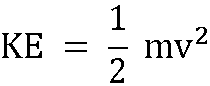
b. Kinetic energy
Kinetic energy is the capacity of doing work that a body has by virtue of its motion.
Importance
i. Helps us do physical work
ii. Machines use mechanical energy to perform tasks.
iii. Moving vehicles, blowing wind all work due to mechanical energy
Limitations
i. It cannot be stored for long time.
ii. It is lost as heat due to friction.
iii. Requires some physical process to convert into useful work.
2. Thermal energy
The energy which flows in out body to give us sensation of hotness and out of our
body to give us sensation of coldness.
Importance
i. Keeps us warm
ii. Used in cooking food and heating water
iii. Used in industries for producing steam and running turbines.
Limitations
i. Heat is lost to the surroundings
ii. Difficult to convert all heat into work.
3. Light energy
The form of energy which enables us to see things is called light energy.
Importance
i. Helps plants in photosynthesis
ii. Used on solar plants to generate electricity.
Limitations
i. Sunlight is not available at night
ii. Intensity of sunlight depends on weather.
4. Electrical energy
This energy is generated due to movement of charged particles. It is used in lighting bulbs, runs our fans.
Importance
i. Used to run appliances like fan, refrigerator and lights etc.
ii. Easily converted into other forms of energy like light, heat, mechanical etc.
Limitations
i. Requires power plants to generate electricity.
ii. Requires proper infrastructure to transport to remote areas.
5. Magnetic energy
Magnet attract a piece of iron and has ability to do work. The energy involve in the
functioning of a magnet is called magnetic energy.
Importance
i. Used in motors, generators, speakers, etc.
ii. Allow magnet to attract irons objects.
Limitations
i. Works in particular materials like iron, nickel and cobalt.
ii. Magnetic field become weak with distance.
6. Sound energy
The form of energy which enables us to hear is called sound. Sound originates when
a body vibrates and produces waves that travel to our ear through a medium.
Importance
i. Helps in communicate.
ii. Used in microphones, musical instrument, sonar etc.
Limitations
i. It needs a medium to travel.
ii. Create noise pollution.
7. Nuclear energy
This energy is released in a nuclear reaction by conversion of mass into energy. This is a non-conventional form of energy.
Importance
i. Produces large amount of energy from small amounts of fuel
ii. Used in nuclear power plants and medical treatment.
Limitations
i. Produce harmful radioactive waste.
ii. Requires high safety standards to avoid accidents.
iii. Costly technology
Q6. Continue to Q5 we know the various forms of energy get converted from one form to another in different situations. Name and explain the law which states this phenomenon of converting one form of energy to another form. Observe your surroundings and give some examples of energy transformation from daily life.
Answer
Law of conversion of energy
Energy can neither be created nor be destroyed. It can only be transformed from one
form to another but total energy always remains constant.
Examples of energy transformation from daily life
We can easily see and understand the energy transformation in our daily life. The
following table will explain this.
|
Device/phenomena |
Energy transformation |
|
Electric bulb |
Electric energy to light energy |
|
Electric heater |
Electric energy to heat energy |
|
Solar panel |
Light energy to electric energy |
|
Microphone |
Sound energy to electric energy |
|
Loudspeaker |
Electric energy to sound energy |
|
Washing machine |
Electric energy to mechanical energy |
|
Photosynthesis |
Light energy to chemical energy |
|
Burning of fuel |
Chemical energy to heat energy |
Q7. Work is measured as the product of force and displacement in the direction of the force but we did not consider whether the work is done in one second or in one hour. However, the time taken to perform a particular work is important, in our daily life. Why it is important to know the rate at which work is done and how will you calculate the rate at which work is done?
Answer
Workdepends on force and displacement in physics but this does not tell us how fast the work is done. But in daily life time is very important.
Why Rate of doing work is important
In daily life, we often need to know how fast a machine or person can perform work
with efficiency and in less time.so the rate of doing work is very important.
The rate of doing work helps us compare efficiency, speed and performance of people, machines and devices.
Calculation of the rate of work
The rate of doing work is called power.
Power= work done time taken
P= Wt
SI unit of power is Watt (1 Joule/sec)
Q8. Two objects of mass 10kg and of mass 3.5kg are dropped simultaneously from a tower. Will they have the same acceleration, when they are 10m above the ground?a) If yes, support your answer with reasons
b) If yes, support your answer with reasons
Answer
Yes , both objects will have same acceleration.
Reason
When an object falls freely, gravitational force acts on it.
Gravity pulls all objects towards the Earth with the same acceleration. This acceleration is called ‘g’.
g= 10m/s2
gravity does not depend on the mass of the object. So both 10kg and 3.5kg objects will fall with the same acceleration of 10m/s2.
Q9. Why road accidents at high speed are much worse than the accident at low speeds?
Answer
Accidents at high speed are more dangerous because high speed give the vehicle more
kinetic energy and this energy cause greater damage during collision.
This means when the speed increases, the kinetic energy increases that cause great
damage.
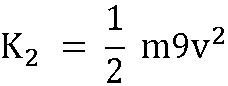
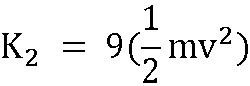
Q10. The velocity of a rocket is suddenly triple. Calculate the ratio of two kinetic energies, if rocket’s initial velocity is v.
Answer
Let
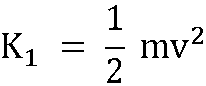
Initial velocity =v
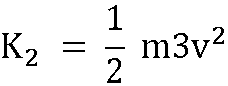
Final velocity =3v
So initial kinetic energy
Final kinetic energy

So, the ratio of two kinetic energies
K1: =1 : 9
Related Topics