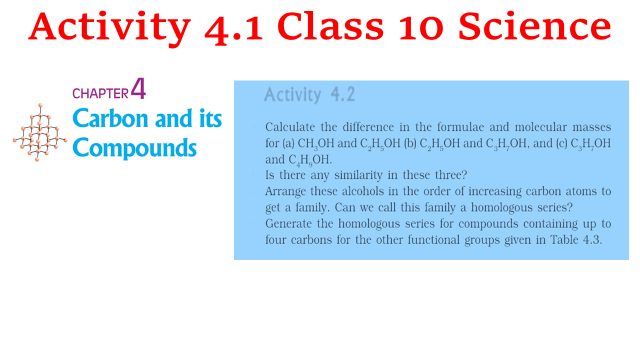
In this activity, we will discuss the differences in molecular formulas and molecular mass in carbon compounds.

Aim of the activity
To compare molecular formulas and molecular masses of alcohols
To understand the homologous series
Materials Required
1. Periodic table
2. Calculator
3. Pen and pencil
Procedure
1. We will write the molecular formulas of alcohol – Methanol, ethanol and propanol.
2. Now we calculate the molecular masses of these alcohols.
3. We compare the differences in formulas and molecular masses.
4. Now we arrange the alcohols in increasing number of carbon atoms and observe homologous series.
5. Finally we use same method for generating homologous series for other functional groups like alkanes, alkenes etc.
Observation

We can observe that:
1. The difference in molecular mass between two successive member is 14g/mol
2. Each compound of a homologous series differs by a -CH2 unit.
3. All members of a homologous series show similar chemical properties.
Explanation
All the compounds given belong to same homologous series because they have same functional group -OH and differs by -CH2 unit and 14g/mol mass.
Other Examples of Homologous Series
(1) Alkanes
ii. C2H6
iii. C3H8
iv. C4H10
(2) Alkenes
i. C2H4
ii. C3H6
iii. C4H8
(3) Carboxylic acids
i. HCOH
ii. CH3COOH
iii. C2H5COOH
iv. C3H7COOH
Conclusion
We can conclude that:
1. All members of a homologous series differ by -CH2 unit in formula.
2. Molecular mass increases by 14g/mol
3. All members have same functional group and chemical properties.
Frequently Asked Questions
1. What is the difference in molecular mass between two successive alcohols?
Answer
14 g/mol
2. What is a homologous series?
Answer
Homologous series is a group of organic compounds having same functional group,
similar chemical properties and all members have difference of -CH2
in molecular formula.
3. What is the difference in molecular formula of two successive members in a homologous series?
Answer
-CH2 unit