This worksheet 11 contains questions based on Chapter 11 Gravitation with complete
answers.

This post explains the answers of questions given in the worksheet including
explanation, diagrams. These solutions will help you complete your assignments and TMA also.
Step by Step Solutions for NIOS Class 10 Gravitation Worksheet 11
A complete solution of Questions given in the worksheet 11 of Gravitation of NIOS
Class 10 Science.
Q1. It is our everyday experience that bodies thrownm vertically upward come back to the earth. Even if an object is dropped from some height, it falls towards the earth. Similarly, tree leaves and fruits fall towards the earth when they are separated from the branches. Explain why does it happen so? Is it same for all objects.?
If we throw an object vertically upward, it comes back to earth. The objects dropped
from a height come to earth and all objects like stones, leaves or fruits fall towards the earth because of force of attraction. This force acts between the earth and every object. This force is called force of gravity or gravitational force.
The earth attracts all objects towards its centre. Yes, it is same for all objects.
Booksbakset.in
Q2.It is well known phenomenon that bodies fall towards the earth due to force of gravity. If the earth can attract an apple or a stone, can it also attract the moon or any other planet?
a) If yes, support your answer with reasons.
b) If No, support your answer with reasons
Answer
Yes, the earth can also attract the moon and other planets.
Reason
According to Newton’s law of gravitation, every object in the universe attracts every
other object with a force called the gravitational force.
This force depends on masses of objects and the distance between them.
Q3. Continue to Q2, explain the force which is responsible for keeping the planets go around the sun in their orbits and moon around the earth.
Answer
The force which is responsible for keeping the planets moving around the sun and
the moon around the earth is gravitational force.
This force acts as an attraction force between the sun and the planets and between
the moon and the earth.So, due to this force all planets and the moon move in their fixed orbits.
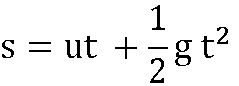
Q4. It is well known phenomenon that g is constant near the surface of earth. Therefore, all the equation for uniformly accelerated motion of bodies becomes valid when acceleration ‘a’ is replaced by ‘g’. write down the modified equation of motion.
Answer
When acceleration ‘a’ is replaced by acceleration due to gravity ‘g’, we have
following equations of motion
1. 
2. 
3.
Where
u= initial velocity
v= final velocity
t= time
g= acceleration due to gravity
s= distance covered
Booksbakset.in
Q5. In general Mass and Weight are considered same. But in Physics both are different. Differentiate between mass and weight and write their units. Also explain the term weightlessness.
Answer
Difference between Mass and Weight
|
|
Mass |
Weight |
|
1 |
Mass is the amount of matter contained in the body. |
Weight is the force which the earth attracts a body towards its centre. |
|
2 |
It remains constant everywhere |
It changes place to place depends on gravity. |
|
3 |
It is scalar quantity. |
It is a vector quantity. |
|
4 |
SI unit – kg |
SI unit – N(newton) |
Weightlessness
A body is said to be weightless when it does not experience any force of gravity or when it is in free fall under gravity.
Example – An astronaut in a spaceship feels weightlessness because both fall freely towards the earth with same acceleration due to gravity.
Q6. Suppose you are standing on a weighing machine in a lift. If the lift is going down with a downward acceleration of 9ms-2, what would be the reading of the weighing machine? Take g = 10ms-2. Justify your answer with explanation.
Answer
Let the weight of the person be W= mg
m= mass of the person
g = 10m/s2
a= 9m/s2
now, when the lift goes downward with an acceleration of 9m/s2, the effective acceleration acting on the person
effective acceleration = g-a = 10-9 = 1m/s2
so, the reading of the weighing machine will be
W`=m(g-a) = 1m
So, the new weight is 1/10th of the actual weight of the person.
When the lift moves downward with acceleration, both the person and the weighing machine fall freely. The downward acceleration reduces the upward reaction force (R ) on the person that the weighing machine shows as weight.
Booksbakset.in
Q7. The force with which an object is pulled towards the earth is called its weight. Comment why weight of any object on the moon is 1/6 time that on the earth?
Answer The mweight of an object depends on mass (m) and acceleration due to gravity(g) at that place
W = mg
The mass and radius of the moon is smaller than that of the earth so moon’s gravity
is weaker than the earth’s gravity.
The acceleration due to gravity on the moon is 1/6th of that on the earth
So the weight of object on the moon

So, the weight of any object on the moon is six times less than on the earth.
Q8. Refer to Q7 and comment
a) Is the mass of an object stay constant wherever the body may be situated in the universe?
b) Is the weight of an object stay constant wherever the body may be situated in the universe?
c) Is the weight of an object stays constant wherever the body may be situated on earth?
d) What will be the weight of an object at centre of earth of radius R?
Answer
a) Yes, the mass of an object always stays constant every where in the universe. Mass is the amount of matter in a body and it does not change place to place.
b) No, the weight of an object does not stay
constant everywhere in the universe because it depends on the value of gravity (g)
which changes place to place in the universe.
c) No, the weight of an object does not remain the same or constant on the earth because the value of g is different at poles and at the equator. The value of g is slightly greater at the poles than that on equator.
d) The weight of an object on the centre of the earth would be zero because the gravitational pull form all sides of the earth cancels out and result force acting on the object would be zero.
Booksbakset.in
Q9. Perform an activity for understanding the concept of Buoyancy. Describe the activity in your own words and explain the term buoyancy or buoyant force.
Answer
Demonstration of Buoyant Force Activity
Aim
To observe the buoyant force acting on a wooden block
Materials Required
1. A large wooden block
2. A bucket/ tank with water
Procedure
We take a large wooden block and place it on the surface of water in the bucket. We observe what happens.
Now we push the block into the water with our hand and notice what happens.
.webp "Demonstration of Buoyant Force Activity")
Next, we push the block further down until it is completely immersed in water. Finally, we release the block and notice what happens.
Observation
We observe that
1. The wooden block floats when it is placed on the surface of water.
2. An upward push(force) is felt when the block is pressed into water.
3. The block bounce back when it is released after immersion in the water.
Explanation
Water exerts an upward force on the object when it is placed in water. This upward force is called buoyant force or upthrust.
When buoyant force is greater than the weight of the object, then the object floats on water otherwise it sinks.
So, all objects experience buoyant force in liquids.
Conclusion
We can conclude that an upward force called buoyant force is experienced by an object when it is placed in water and this force make the object float or sink depending on the weight of the object.
Buoyancy (Buoyant force) – The upward force exerted by the liquid on the object when it is immersed in liquid is called buoyant force. This is also known as upthrust.
Q10.State Archimedes’s principle. Observe your surroundings and write application of Archimedes’s principle in day-to-day life.
Answer
When a body immersed fully or partially in a fluid, it experiences an upward fore
that is equal to the weight of the fluid displaced by it.
Applications of Archimedes’ Principle in Daily Life
1. Ships and submarines are designed on this principle to float or sink in water.
2. Hydrometer and lactometer are based on Archimedes’ principle to measure the density of liquids.
3. Hot air balloon rises in the air because the buoyant force of air.
Related Topics
1). NIOS Class 10 Science Worksheets Solutions Set 1
Booksbakset.in